
Key Factors addressed by CTO
The CTO mechanism is involved in non-voltage dependent calcium signaling, addressing several factors in malignant gliomas.
- Angiogenesis: Demonstrated reduction in exosome-stimulated angiogenesis and both VEGF expression and secretion
- Proliferation: Reduction of proliferation, adhesion, motility and vascular tube formation
- Anti-Inflammation: Inhibition of inflammation has been demonstrated, accompanied by reduction of reduction of TNF-α, IL-1β, IL-6, TGF-β, IL-8 (all increased in COVID-19). In Phase 1, in 3 cancer patients CTO inhibited VEGF, GM-CSF, INF-ɤ, IL-6, IL-8, MiPiα, IL-1β and TNF-α.
- Molecular Targeting: Through non-voltage dependent calcium signaling, several transduction pathways are impacted, including multiple tyrosine kinase signaling pathways. Crosses the Blood Brain Barrier and reaches the CSF.
- Overcome Drug Resistance: Augments apoptosis through inhibition of tyrosine phosphorylation of BCr-Abl, ERK, and Wnt-β-catenin, offering a plausible mechanism by which CTO circumvents chemoresistance to Temodar® and other drugs.
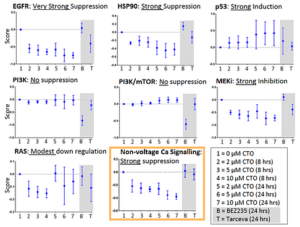
Based on pharmacodynamic markers, CTO has a suggested mechanism of action that inhibits genes associated with non-voltage dependent calcium signaling, which ultimately translates into the inhibition of multiple oncogenic pathways.
Pharmacodynamic Transcriptional Markers of CTO Exposure in ex vivo Anagen Hair Assay
Assay Results:
- The transcriptional signatures associated with inhibition of EGFR, MEK, HDAC and HSP90 were strongly suppressed at all doses of CTO
- Genes associated with non-voltage dependent calcium signaling were strongly suppressed, with RAS and Growth Factor Signature
- Modest suppression of transcription signatures of WNT signaling was evident at longer exposure to CTO
- In contrast, activation of tumor suppressor signatures associated with P53 was observed Through non-voltage dependent calcium signaling, CTO impacts several transduction pathways, including multiple tyrosine kinase signaling pathways
These results may provide the molecular MOA of CTO’s observed clinical benefit in a broad spectrum of tumors with different genomic types and a tool to design customized combination therapies of CTO with other agents.
Source: EORTC Abstract A233, October 19-23, 2013; 2013 ASCO Breakthrough Session: Abstract 115114
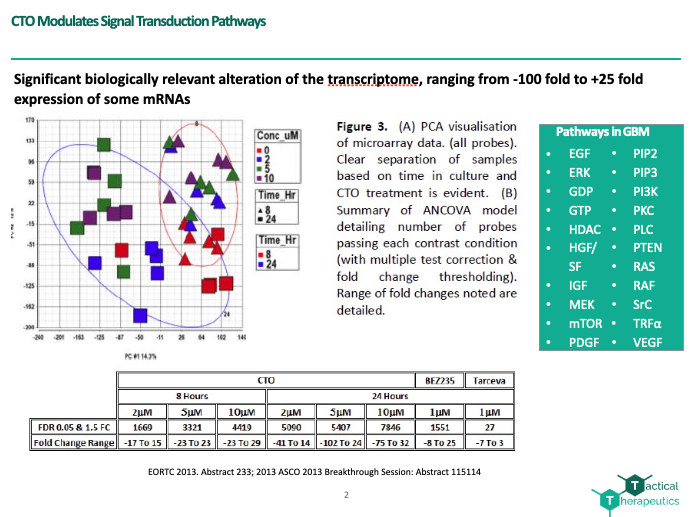
Preclinical studies demonstrate that CAI, the active component in CTO, inhibits VEGF, Akt, and Erk activity.
A murine glioblastoma xenograft model demonstrated that CTO in combination with Temodar significantly inhibits tumor growth.
Study Purpose
The primary purpose of the experiment was to evaluate the antitumor efficacy of CTO with or without Temodar in glioblastoma using a mouse xenograft model
Methods
- U251 human glioblastoma cells were subcutaneously implanted into male, athymic NCr-nu/nu mice.
- Mice were treated with CTO and/or Temodar for two rounds on a Q1D x 5 schedule over a period of 76 days
Efficacy
- Treatment with CTO resulted in a statistically significant decrease in tumor growth. Treatment with Temodar + CTO resulted in greater inhibition of tumor growth than either product alone. The antitumor activity of the combination treatment was greater than the additive activity of both compounds alone showing chemosynergy with Temodar + CTO
- CTO demonstrated the ability to cross the Blood Brain Barrier in preclinical models and in GBM patients.
Source: Karmali, RA., et al., Cancer Therapy 2011, 8:71-80.

CTO Intellectual Property Overview
Tactical Therapeutics has an extensive IP estate, including the key patents lasting through 2037 listed below.


SOC = Standard of Care